
It's been a year since I last wrote to you.
I could tell you I was busy, or that life got in the way. But the truth is simpler and harder: I stopped because I realized I was holding back the very thing that makes my work alive.
You know that feeling when you're speaking but not saying all that you want to say? When you're showing up, but not fully, and part of you knows it? That's where I was. I had built a practice, a website, a newsletter, a way of presenting my work that was... good. Professional. Credible. But something essential was missing. I was holding back. I was afraid.
I was afraid that not many would accept the soulful depth and connection that lives at the heart of how I actually work.
So I edited it out. I led with the research, the environmental psychology, the biophilic design principles—all true, all important—but I kept the deeper dimension quiet and somewhat hidden: the intuitive listening, the inner work that shapes the outer work, the understanding that comes from active listening to the unsaid, unseen, untouched, that comes from true connection within and with all that is.
I couldn't continue writing the way I did. So I stopped. There was a call to realign my outer world—work and voice—with my inner world: my heart.
What Happenes Beyond the Shell
The seeds of this realignment were planted years ago. Back in 2014, when I realized that my home, although beautiful and very well designed, didn't reflect my essence and authentic self. This led me to go back to the books—studying holistic interior design, biophilic design, and environmental psychology—and to establish the wellbeing interior design practice. I discovered how to help people uncover their true sense of beauty and style—well hidden under decades of media and social conditioning. Through this work, I established a unique exploration and discovery process that was not learned from any book but came purely from contemplation and connection with the natural world. Encountering Martin Pietsch, a building artist and architect in Tamera, Portugal, and learning his approach to design—how he sits with a site for days, sometimes weeks, listening to all beings and to the elements, letting the structure emerge from deep attention to place and nature. These experiences stayed with me, working beneath the surface.
In early 2025, I started feeling, once again, new hints that something needed to change. By fall, those seeds began to germinate quietly.
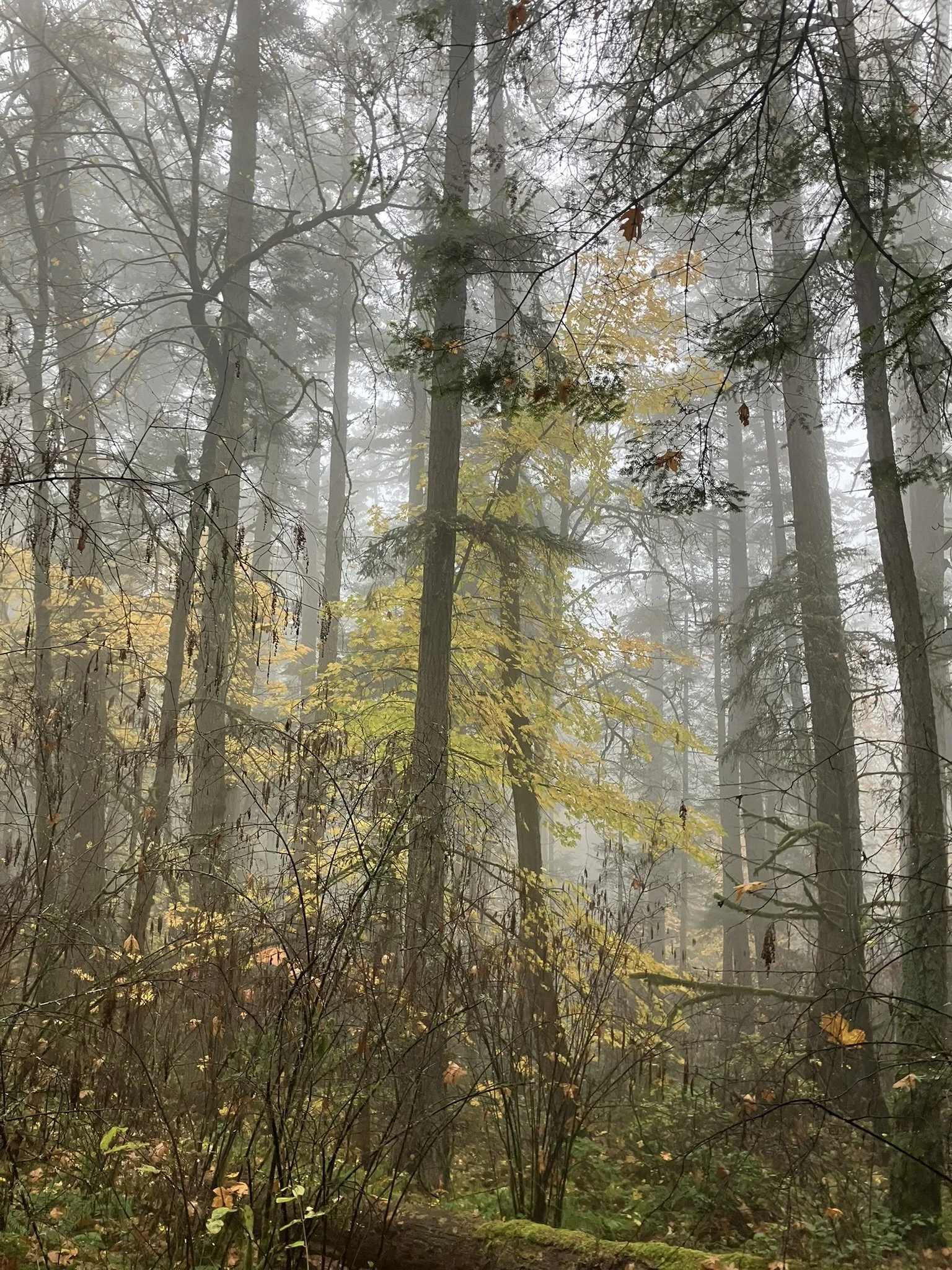
I took time for silence and solitude. I walked. Long walks in wild nature, where the only presence was silence and the spirit of the forest, sitting with the questions: What does my authentic voice want to say? How can I show up truly and fully? What truth wants to emerge? Questions that David Whyte refers to in his poem Sometimes as "questions that have no right to go away." It was the kind of silence that breaks you open and shows you what you already know but have been afraid to speak.
The answer that emerged wasn't new. What I am doing—my work—is my true calling. It was the permission to show up fully. To stop apologizing for the depth. To let the research and the intuition breathe together, inseparable. To trust that what emerges from silence isn't separate from my professional qualifications. They are the qualifications.
This is what it is: connection with my authentic voice and the courage to let her be seen.
How I work
I work from a place where environmental psychology research and intuitive listening aren't in tension—they inform each other. When I enter a space, I bring knowledge of structure and functionality, the principles of design, how different elements affect our nervous systems, and the capacity to sense what a room is asking for, to uncover what lies beneath—authentic but hidden—in each client and group. The biophilic design principles and the poetry breathe together.
The lived experience matters. The time spent in communal living taught me things no textbook could about the nature and challenges of shared living, what causes conflicts to rise, and how people actually navigate shared space. Studying ecovillage design and the socio-economic elements, permaculture, Council and Forum, etc., greatly informs designing for communal living and communities, something we don't study in design schools.
Observing and listening to the natural world taught me what nurturing spaces feel like from the inside—not as theory, but as embodied knowing.
And it means showing up in my work and in my writing fully, without hesitation or concern. The soulful depth isn't a liability. It's the gift.
How things will look like going forward?
As for the newsletter, you'll hear from me every 4-6 weeks, when I have something real to say and share.
I want to explore the experience of living well, living authentically—with you—sometimes through research, sometimes through poetry, sometimes through the questions I'm sitting with. I'll share what I'm learning about creating spaces that nurture rather than deplete us. Projects I'm working on. Challenges and excitement. Personal adventures in nature connection. Unconventional approaches to designing, people and projects that inspire me. The spiritual journey and the design journey as one path.
If you've been following Well by Design, I invite you to visit the newly reimagined About page. It tells the full story of how I work and what I bring—not the edited version, but the whole truth. Read it if you've ever sensed there was something deeper here and wanted to understand what that is. And if you have the curiosity and time, I invite you to look through all the pages, as everything has been updated with this breath.
And if you're working on a space—a home, a retreat center, a community place, a workplace—and you sense it needs this kind of attention, this integration of research and soul, this listening... reach out. This is the work I'm here to do.
Thank you for staying through the silence. Thank you for being here as I step fully into what was always true.
With deep gratitude,
nora